Monthly Archives: October 2012
RCUK launches research career case studies to inspire young people
Research Councils UK (RCUK) has today (8 October 2012) published an online suite of case studies designed to inspire the next generation to think about pursuing a career in research.
Find out more at: http://www.rcuk.ac.uk/media/news/2012news/Pages/121008.aspx

Finding usable images with Wikimedia Commons
Creative Commons (CC) licences allow images (and other content) to be used without the traditional ordeal of obtaining copyright permission from the creator (or the greater ordeal of being sued for infringement). They are a valuable tool for anyone creating digital content (such as presentations), particularly if the content is to be hosted online. This post explains how to find and use CC images using Wikimedia Commons.

Citation analysis tool – Publish or Perish
This is one of a series of posts describing tools that are available for citation analysis. For other tools see here.
Harzing’s Publish or Perish (PoP) “is a software program that retrieves and analyzes academic citations. It uses Google Scholar to obtain the raw citations, then analyzes these and calculates a series of citation metrics.” (Publish or Perish User’s Manual, 2012)

Citation analysis tool – Google Scholar
This is one of a series of posts describing tools that are available for citation analysis. For other tools see here.
Google Scholar is the ‘academic’ version of the popular Google search engine. It covers scholarly literature from a range of sources, including “academic publishers, professional societies, online repositories, universities and other web sites” (Google, 2011). What Google doesn’t tell us are the names of these sources (i.e. which publishers, journals etc. are harvested) or the frequency of updates. This means that we cannot be certain how comprehensive a search is or how up-to-date.

Citation analysis tool – Web of Science
This is one of a series of posts describing tools that are available for citation analysis. For other tools see here.
Web of Science is one of the leading databases of scholarly research articles, covering a broad range of subject areas. As a commercially provided database it features a number of added value services, including a sophisticated search function, links to cited and citing papers, citation reporting and an alerting service.

Citation analysis tool – Microsoft Academic Search
This is one of a series of posts describing tools that are available for citation analysis. For other tools see here.
Like Google Scholar, Microsoft Academic Search indexes millions of scholarly papers but unlike the Google product it offers a range of extra features, among them citation counts and the facility to follow citation paths.

Tools for citation analysis
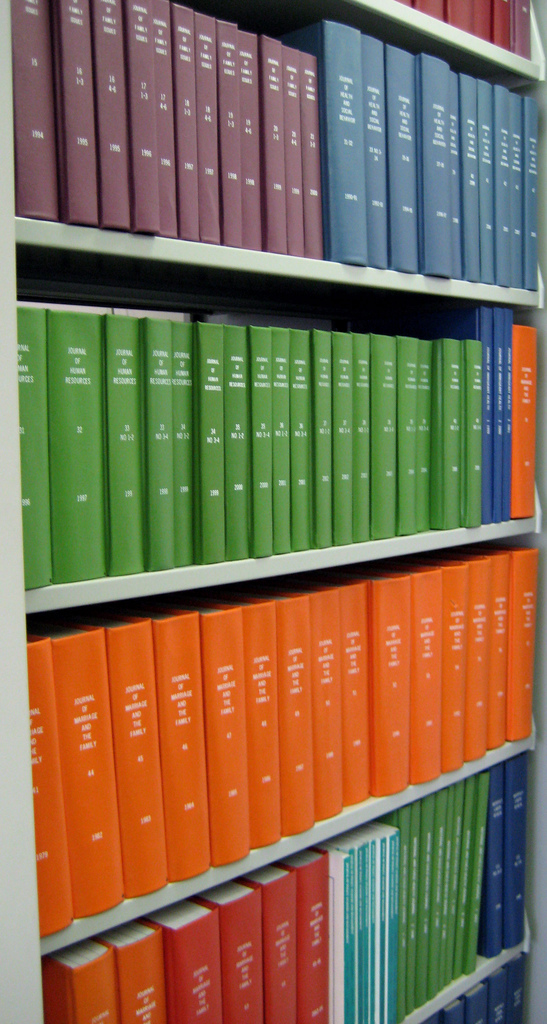
FAQ: How can I find out which works are most cited?
Even though the decision has been made not to use citation counts as the primary measure of research excellence in REF2014, there are several good reasons why you might be interested in the number of times your work, or that of others, has been cited. For example:
- to measure and track the uptake of specific research outputs by the scholarly community
- to enhance bids for funding
- to demonstrate personal, group and institutional research performance
- to support career advancement
In this series of posts I will introduce some of the tools that you can use for citation analysis and explain briefly how you can access them.

SPSS software now available as a download
FAQ: How can I get hold of a copy of SPSS for my personal use?
Copies of SPSS software can now be downloaded directly to your laptop or home computer. There are versions for both Windows and Mac operating systems.

Rewriting the Rules? Non-monogamies and other adventures in non-normative relationships
There will be a seminar on Wednesday 31st October from 3.30pm until 4.30pm in Cottesbrooke, C204 for staff and research students (although interested masters and undergraduate students are welcome too). The speaker is Meg Barker from The Open University and she will be talking about her research on non-monogamous relationships. Below is an abstract for her talk and a biography. I hope to see as many of you there as possible. Refreshments will be available.
Dr Helen Clegg
Senior Lecturer, Division of Psychology
Read the rest of this entry

PhD transfer seminar “Fine sediment dynamics in the Nene river basin”
Research student, Simon Pulley, will be presenting his PhD Transfer seminar entitled “Fine sediment dynamics in the Nene river basin” on Thursday 18th October at 1330 in Newton NW013.
All are welcome to attend.
Thumbnail credit: Jon Smith (Flickr) – Creative Commons
 UON Graduate School Blog