Monthly Archives: May 2026
Being Comfortable with Being Uncomfortable: Lessons from a NATO Advanced Research Workshop (ARW) in Türkiye
Blog post written by: Ian Hall
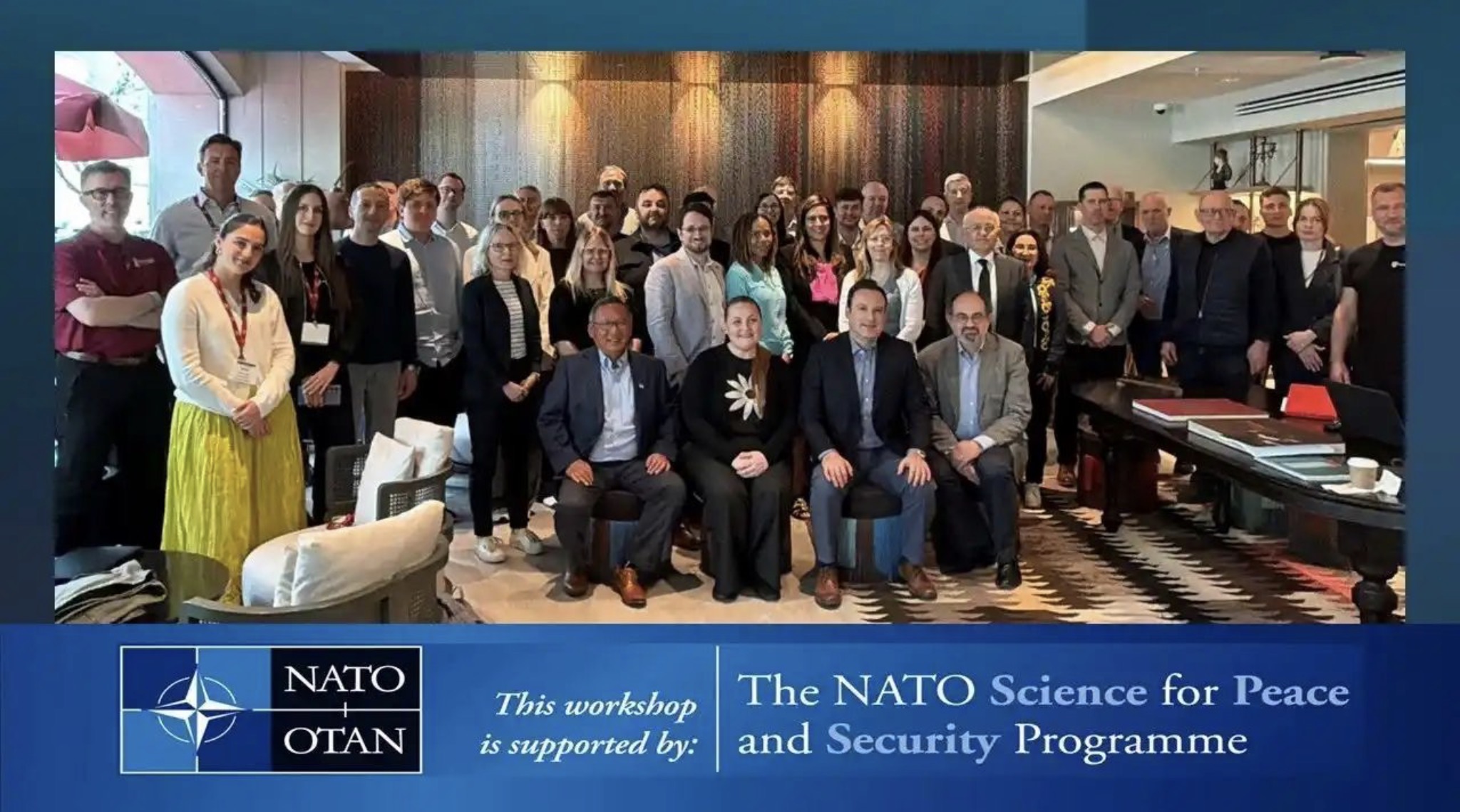
Attending a NATO ARW in Türkiye last month was an exercise in learning how to get comfortable with being uncomfortable. From the outset, the workshop felt like a new Community of Practice I had joined, alongside others working in resilience modelling, supply chains, and contested logistics, areas where I have little technical expertise. Despite that formal inclusion, I felt the unsettling presence of imposter syndrome.
When I arrived, there was an immediate sense of belonging. Several participants were people I already knew from previous ARWs, however there was a much larger group of world-leading experts that I had not previously met. Chatting to senior military leaders, resilience modelling experts, and people embedded in governmental policy, I became aware of how far out of my depth I felt.
Despite feeling accepted by a, I still felt like an outsider in conversations with others. Rather than withdrawing, I decided to approach rest of the workshop with a deliberate intention: to network, seek out new knowledge, with the aim to connect the specialist expertise of others with my more generalist understanding. That approach did not eliminate the discomfort, but it gave me a way through it. In my PhD, I find I must stay present in unfamiliar debates long enough for them to become part of my thinking.
A turning point for me came during a Working Group session. Tasked with producing an outline for a book chapter on the tools and methodologies for modelling resilience in supply chains and contested logistics, I found that only one had participated in a previous ARW. It was here that I realised my knowledge could play a meaningful role. Having worked on book chapters from previous ARWs, I was able to connect specialist contributions into a coherent structure, an experience that mirrors the PhD task of shaping diverse literature and ideas into a robust argument.
As the work progressed, I felt more comfortable acknowledging what I did not know while still contributing value. Around two-thirds of the group were practitioners rather than academics, working in highly specialised areas of industry. Sitting at the intersection of academia and industry, I realised this dual role carved out a niche I had not fully recognised before.
Looking back, “being comfortable with being uncomfortable” is not a slogan but a practice. For me, it means acknowledging the tension of being inside a Community of Practice. It means choosing curiosity over retreat, listening carefully, asking questions, and engaging honestly with uncertainty. Those conversations revealed something important: others were often equally uncomfortable, but less willing to name it. The same pattern shows up in my PhD journey, where my confidence often grows not from certainty, but from staying engaged with ambiguity.
The workshop reminded me that imposter syndrome is normal when entering a new Community of Practice and is not a sign of failure or exclusion. It often signals learning; when expertise is deep and diverse, discomfort may be inevitable, even necessary. That is the reassurance I am taking into my PhD: the uneasy moments, when the theory feels unfamiliar, or my contribution feels small, are often the moments in which my thinking is changing and learning is taking place.
The PGR Induction Experience
For me, this was re-treading old ground anew. For me, this was a small, calm homecoming. Although I have been back to the Northampton area since I was last a student there a few years ago, I have not set foot onto campus in quite some time. Not since I was robed out for a graduation. That ceremony in all its robed circumstance felt like the termination of something special; now, being inducted once more at the University of Northampton, that special something is being revisited and re-experienced. That being my ongoing relationship with this incredible institution. If I sound whimsically nostalgic to the point of emotional, that is because I very much am – I did both my BA and my MA with UoN. Returning in 2026 for my PhD is a full circle moment and also an arrow fired into the unknowable future. The campus hasn’t changed since I was last here those few years ago: it’s still square and grey and shiny, it’s still clean and sparse yet alive with action and business, but I feel very different. When I first came here for an open day I was seventeen, clueless, overwhelmed and less well-academically clued in than I am these days. Now, at twenty-five, I really appreciate UoN for what it is when I step once more onto the contours of campus – it is a space for curious minds to come up for air, it is curvaceous glossy buildings dedicated to your passions, it is endless helping hands and wise minds. Being here again reminds me of why I want to join everyone in the pursuit of the academic. This time round, however, I’ve got no classmates, no cohort, no lecture timetable – there’s just me and my doctoral project. That really is quite thrilling.
Induction for Post-Graduate Researchers is a four day event. As someone from out of town, and therefore someone who will be doing their PhD nearly totally remotely, that means a lot of thinking time commuting in the rush hour traffic for four days. I think about how many times I have done this journey since I was an undergrad fresher in 2019; I could drive it blindfolded. I think about how unbelievably lucky I am to have such a strong supervisor team and academic department to guide me over these next years of study. I think about how, this time, I am going to take a good ID card photo as the last two were so dire. Alas, on the first morning, I am given a new sparkly university email address and a new pre-printed ID card. Whilst the turnstiles are now open to me, I don’t spot any cameraman. Then I see it: the photo of myself I had to upload for my application. I stare back at myself from the small white rectangle that unabashedly boasts the end date for my course six years from now. A scary date, but a good ID photo finally. We’re off to a good start.
In terms of information and being informative, UoN’s PGR induction program is top of the range. Inductees are spoilt for information. Indeed, by the fourth day, I have received enough factoids, titbits, pieces of advice and resources to satiate six years of doctorate study. And, as a tried and tested technophobe, I have even started to be converted to the university’s multitudinous systems. The main takeaway: don’t get overwhelmed, it’ll all make sense fast. And whatever doesn’t, doesn’t matter! I am now a few weeks into my project and the overwhelm has subsided as I have made sense of everything that is thrown at inductees. Keep your eyes and ears open during induction sessions – it will all come in handy at some point. I thank every person involved in all four days, in particular their welcoming demeanour. I always feel that I am in safe hands, that any question will be answered, that everything has been thought of. I am reminded of how I felt at eighteen starting my undergrad: UoN knows how to take care of its students and researchers.
Lunch is also provided each day. Never turn up such a rare opportunity for a free meal. Thank you to the caterers, you made a room of anxious inductees much more relaxed.
The induction took place at the proverbial top of the world: the Learning Hub’s Leatherseller’s Hub, with a panoramic view of Northampton town. For mid-March, the weather was stunning. I constantly found myself staring past the sessions’ screens and out to the cloudless skies over the four days, and feeling giddy to be back as a student. I have so many memories in this library. Indeed, on the first day of induction, I went to my favourite section of the fourth floor bookshelves as I used to a daily basis on my undergrad. I picked up the books that I read in my first year, still sat on the shelves ready to be explored again. I thumbed through copies of texts I had snuck into the library for in my face mask during my years of lockdown degree. Now I select books that I will use for my PhD – a project I never actually thought would come to be. It is only by the generous encouragement and support of UoN staff across both my department and the graduate school that I have felt brave enough to take on this next academic level. Having felt that it was beyond reach since graduating from my MA, I feel proud to be starting my PhD experience.
My doctorate project is a personal one for me. One of the most fascinating takeaways from the induction week is actually how different each person’s project is from everyone else’s in the room. Indeed, whilst I watched many of my colleagues grapple with data handling, research plans, the nitty-gritty of medicine, computing, law, psychology, I felt far more abstract. My project is a PhD By-Practice, specifying in creative writing. Rather than conducting a study or research, instead of number-crunching and interviewing participants, I have to simply…write. There’s more to it than that, of course, and I believe in the proposal I have set out with the university, but a lot of the induction sessions I felt didn’t apply to me in my creative bubble. This, of course, is not the case; each session contained something vital on how to be a PGR. Whether ethics, integrity, or the turmoil of using all of the sites and online tools available to students, there is a lot of responsibility to doing a doctorate, and the induction days presented these with the correct jovial gravitas.
As I begin my project, and the creative juices start to flow, I am keeping in mind that I am now a part of something bigger, that something special I mentioned earlier – I am now another member of the University of Northampton’s respectable research machine. I am part of its academic community; I am once again undertaking exciting studies in an institution I know and trust. As are all my fellow inductees, all about to branch off in newfound thought-provoking pathways of PGR-ing. With my new black lanyard in hand, and a few obligatory online courses to tackle, I depart from campus on the last sunny day feeling fulfilled, daunted, energised and ready to start researching. Four days down, six years left to go…
Blog post written by: Joe Butler
 UON Graduate School Blog