Three Months In: How My PhD Journey in Parapsychology Began (And Why It Feels Like Coming Home)
Blog post written by: Dr Heidi Kharbhih
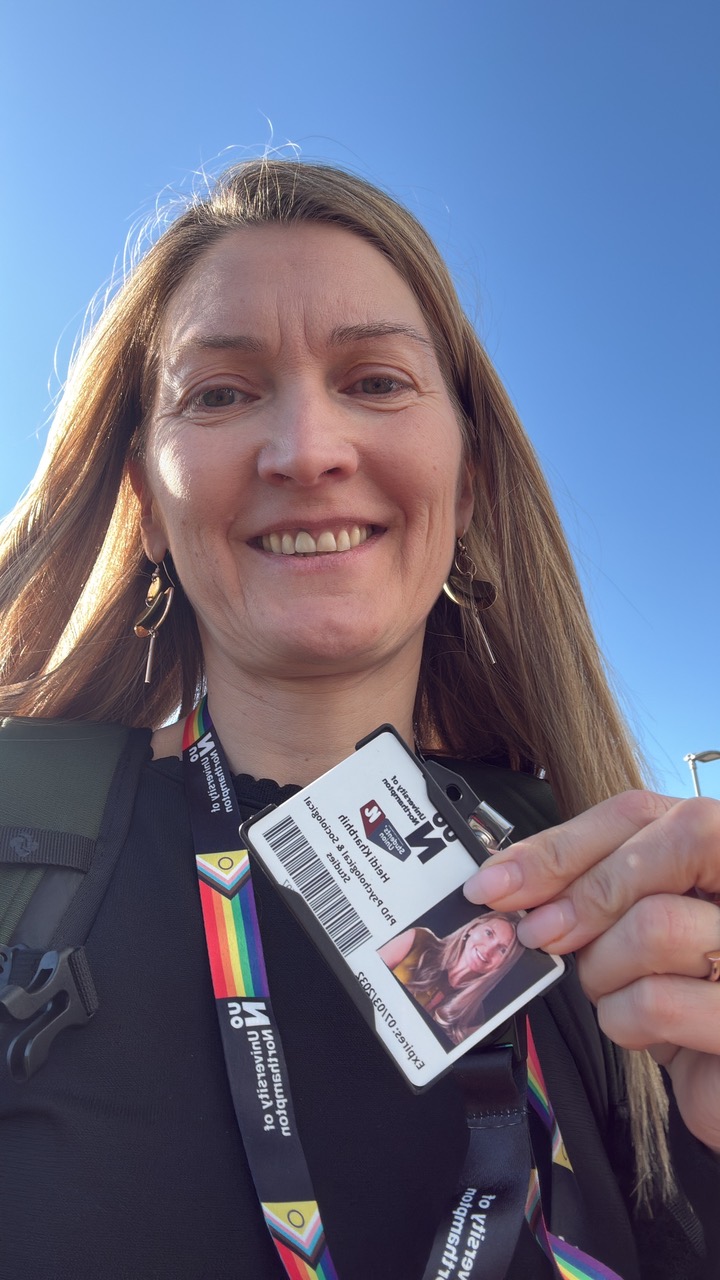
3 months since I started my PhD at Northampton University and I’m loving it!
You know when life flows and things just fall into place, well that’s exactly my experience with starting this research. In this article, I want to share the journey so far, how I chose my research topic, the application process, securing funding, what the first 12 weeks involved, my early supervisory meetings and some reflections on what it feels like to return to academic research in a field that has fascinated me for years.
Before applying to a university you first need a research topic. Choosing mine took a lifetime. To explain why, I need to take you back to 2015. I delighted in reading books like Rhonda Byrne’s The Secret and Journey of Souls by Michael Newton, During long car journeys, I listened to podcasts featuring Seth material and Esther Hicks. While doing the ironing I watched documentaries exploring consciousness and quantum theory. I attended psychic development courses and became captivated by subjects related to personal growth, spirituality and human potential.
Over time, I trained as a life coach, meditation practitioner, Reiki master, trauma-informed breathwork therapist and in several other complementary disciplines. I integrated these approaches int my work, tailoring support to the needs of individual clients. As I continued my own personal development, something began to shift. My priorities changes. Abilities and intuitions that had ling been dormant seemed to re-emerge, and I developed a growing sense of connection to something larger than myself.
Anyone who embarks on a deep journey of healing and self-discovery may recognise this experience. As old patterns fall away, you begin to understand more clearly who you are and who you want to become. Sometimes the activities, environments, and even relationships that once felt aligned no longer fit the person you are becoming. It was as though I got an upgrade to Heidi Version 2.0.
Meditation became a daily practice and one of the highlights of my day. It was not unusual for me to meditate for two hours or more a day. Had I not had children, I might have disappeared into a monastery – or perhaps a nunnery – to meditate all day. It was wonderful, the peace, love, joy and sense of connection it brought me were unlike anything I had ever encoutered before. This was a journey I wanted to go deeper with, what began as a curiosity became a calling.
As my gifts manifested, I connected with other worldly spirits, I saw things others could not see, I received messages from a higher intelligence, I knew things before they happened, I sensed things beyond the physical. These experiences did not fit the material world and Newtonian physics we are taught at school. Yet they were more real and resonated so deeply I could not deny them. I began to speak of these events with my friends and family and would often get strange looks and quizzical smiles, a nod followed by awkward silence. Other times, someone would divulge in a whisper something similar happening to them. In this society extraordinary abilities are a taboo subject, the word “woo woo” and “crazy” would be used to dismiss events and keep the experiencers quiet. So the research goes underground, you find a few people like you who are open and curious and you share in those special circles. I wanted to hear more from others like me and understand their journeys. How did they develop their extraordinary abilities? Had they always had them? Did it run in the family? This is the most fascinating part of my life, it’s a whole other world that brings so much meaning into my existence, the reason why I am here.
In Autumn 2025 I decided to pursue academic research opportunities. A search online revealed a few specialist departments in the world. I was already aware of IONS and The Monroe Institute but I wanted something based in the UK. I’d taken courses at the College of Psychic Studies and was aware of the Arthur Findlay College but when investigating grants and research, I discovered you could actually undertake research in parapsychology at University. If I had known this 30 years ago, I certainly would not have done Mathematics (my first PhD)! Edinburgh and Northampton both had respected research departments, I made my enquiries. I was leaning towards Northampton because they are one of the few universities where paranormal topics are an established research area and they have strong connections to the wider psychical research community (such as the Society for Psychical Research, The Tanous Foundation, California Institute). Prof Cal Cooper was quick to respond and invited me to the SPR conference 18/19 October. I listened to talks from people like me, on subjects I had been interested in for years. It felt like I belonged. Meeting with Prof Chris Roe and Prof Cal Cooper at the end of the event, I discussed my initial research ideas. Cal invited me to the Broughton Award on 14th November held by the ‘Exceptional Experiences and Consciousness Studies’ research group and gave me a tour of Waterside campus. I was particularly enamoured with the Ganzfeld set up. We discussed my draft research proposal, requirements for submission, timelines and potential funding routes.
27th November I had an online meeting with Chris Roe and Cal Cooper and received some useful feedback on the scope of my research. I made a few tweaks to my research proposal.
1st December I submitted the revised proposal and made a formal application to join the postgraduate research programme on the Northampton University Admissions portal. Hoping that funding would follow, as the fees were a prohibitive factor for me.
8th December, I applied for a research grant from the Tanous Foundation, attaching my research proposal.
18th December, I had an induction meeting with Chris Roe and took part in one of the Ganzfeld research experiments, which was really fun.
23rd December I received an invitation from Michelle (the admissions tutor, for an interview the following month.
22nd January I attended the online panel interview, which Chris, Cal and Michelle attended.
23rd January I received an unconditional offer for a part-time 6 year PhD in Psychological and Social Sciences. This was so exciting. I was going through some personal struggles at the time (getting divorced, moving home, setting up from scratch, single parenting and all that), so the news really did lift me up at a time when I needed it most.
23rd February, I received confirmation from the Tanous Foundation that they approved my funding request and would cover the full fees for the first year, as well as provide extra funds to attend conferences. I was absolutely overjoyed.
Everything fell into place so easily.
The PGR induction 16-19th March on campus was incredible. Such a thorough, welcoming, friendly, informative few days. 20+ postgraduate researchers attended the talks and workshops about ethics, research methods, publications, library resources, software, log/ins, campus tour, meeting other postgrads and sharing free lunches together. The induction was amazing and the free resources (endless training courses and access to publications) that the university provide researchers are incredible.
1st April was my first supervision meeting with both Chris and Cal. We talked about the expectations I have from my supervisors and they have from me and we agreed our way forward. I had already completed the compulsory online ethics training modules so at least that box was already ticked off. I shared some ideas I had about my literature review approach, initially thinking I would explore a PRISMA based approach. Which is a structured method of identifying , selecting and synthesising research using predefined criteria to answer a narrowly focused question. Chris gently recommended I look at the pros and cons of that approach versus other approaches.
22nd April, at my second supervisory meeting, I shared my findings and my choice not to follow the PRISMA approach after all (good call Chris). Instead I selected an integrative approach to include diverse literature across qualitative, quantitative and interdisciplinary domains, ensuring a broad and inclusive evidence base. I wanted to apply a critical review lens to identify patterns, themes and dominant frameworks, while also challenging the underlying assumptions and highlighting theoretical limitations and gaps. There was only one thing holding me back, I did not know where to find the relevant publications to ensure my search was comprehensive. My previous PhD was a very specific field in Mathematical modelling with explicit key words and only 2 prominent researchers in the field so the pool of papers was extremely narrow and easy to identify. This research however is exploring the developmental pathways to extraordinary human abilities. The field is huge, there are tens of thousands of publications on psi, telepathy, mediumship, energy healing, shamanism, consciousness studies, and so on. How do I make sure I extract all the relevant published works? Cal shared 7 key parapsychology journals with me and recommended I go through all the titles and abstracts of the past publications and pick out the papers that are relevant to my research. This I can do. Hhmmm so how far back do I go? 30 years? More? I don’t know yet.
Inbetween my second and third supervisory meetings Chris asked me if I would like to be a student representative on the Social Sciences Research Degree Board. Typically the meetings are every quarter for 2 hours. As a student rep, you ask the other postgraduate researchers if they have any issues they want to raise and you represent them in the meetings. I attended as an observer on 11 June and was given a warm welcome by the Board.
12th June, in my third supervisory meeting, I shared my experience and approach of exploring the journal publications. There is more in the field than I first thought, which I am happy about, as it will help inform my approach to interviewing experts with extraordinary abilities and which questions to ask. I have been collating book and papers. As I read each one, if I find the topic relevant, I record 3 things.
1. What the research is exactly. along with my impressions and a few quotes that resonate with me
2. Recommended steps to awaking your extraordinary abilities or noted positive correlations
3. Methods of investigation, e.g. which questions did they ask their participants?
During this meeting, we also talked about future conferences and what I could present where and agreed to aim for a presentation in September and a November presentation at SPR, which could double as my preparation for Transfer. Chris and Cal shared that my Initial Research Proposal has been reviewed at the SSRDB and I should receive an email shortly. They were determined not to spoil the surprise, so fingers crossed.
In my fourth supervision meeting, scheduled 29th July, I will share some of my literature review findings with Chris and Cal. At the moment it’s just a vast collection of ideas without a connecting flow, so I will try to put it into a logical order ahead of that meeting as well as read, read and read some more.
So 12 weeks into my PhD and I am already feeling slightly less like an imposter and more like an expert, starting to recognise the key names in the field and learn all the terminology. It really is another language. Slowly making progress and thoroughly enjoying the process. Shout out to The Tanous Foundation, all the amazing PGRs from the induction and all the staff and researchers in my department. I have deep gratitude to know you and be an active part of this wonderful supportive community. Thank you.
Posted on July 2, 2026, in Doctoral journey, Graduate School, PGR Blog Posts and tagged Graduate School, PGR Blog Posts, Postgraduate research students, Research Degree Students. Bookmark the permalink. Leave a comment.


Leave a comment
Comments 0