Author Archives: David Watson
Top tips for doctoral examiners
In this article, Prof. Pam Denicolo gives her tips for those new to examining doctoral candidates.
https://www.timeshighereducation.co.uk/tips-for-doctoral-examiners-its-all-in-the-preparation

™, © and patent pending: unpicking intellectual property rights with IP Tutor
We all use intellectual property and we all create intellectual property, but the intricacies of IP law are often daunting. IP Tutor is an online course from the government’s Intellectual Property Office. For the low price of half an hour of your time it will help you understand the role and value of IP, whether you’re building on the work of others or maximising the potential of your own output.
Computing staff present on the value of volunteering and robotic problem solving
Submitted by Dr Scott Turner.
Two members of staff from the School of Science and Technology recently presented and chaired sessions at the 11th China-Europe International Symposium of Software Engineering Education, in Zwickau, Germany.
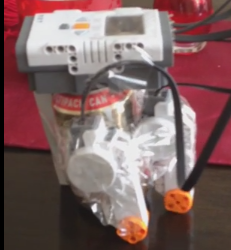 Dr Scott Turner, Associate Professor in Computing and Immersive Technologies, presented work on the importance of volunteering as a method of improving computing students employability. Gary Hill, Head of the Department of Computing and Immersive Technologies, presented an overview of teaching of programming and problem solving to undergraduate first year computing students, using robots/robot simulators and visual programming to emulate the robot tasks.
See NECTAR for other Computing & Immersive Technologies outputs.
Image: Lego junkbot by Scott Turner.
Resources for researchers – Elsevier Publishing Campus
Elsevier have produced a series of free resources for researchers in their Elsevier Publishing Campus.
They say, “The role of researchers is changing. Together with your research tasks, you have increased pressure to secure funding, collaborate internationally, share your data, publish your results, commercialize your research and have demonstrable impact. Elsevier is committed to supporting you in meeting these pressures that bring multi-faceted challenges in today’s increasingly competitive environment.”

Information on the Research Excellence Framework
Posted on behalf of Prof. Simon Denny
The following resources about the REF may be of interest to researchers reflecting on REF2014 and planning for REF2020:
From HEFCE’S REFlections conference – The presentations, project synopsis and completed project reports are available online at http://www.hefce.ac.uk/REFlections
From HEPI-Elsevier Research Conference – The speaker presentations are available for download at http://www.hepi.ac.uk/2015/03/31/hepi-elsevier-conference-reflections-ref2014-next-royal-society-31-march-2015/

A brief history of your h-index
Join campus Columbo Professor Jeff Ollerton on an intrepid adventure to calculate the evolution* of his Web of Science h-index, using nothing more than an online database, an export file and a copy of Excel and some coffee.
It’s unfortunate that this isn’t a built-in function, because it’s interesting information that wouldn’t be too difficult for WoS to provide. But Jeff has a straightforward* procedure for extracting and presenting the data, and his post also discusses the value of the exercise beyond academic curiosity.
* Use of term may not be scientifically accurate. Sorry, Jeff.

Dr Mike Daniel Research Degree Scholarship – £500
The deadline for applications for the Mike Daniel Research Degree Scholarship is the 15th May 2015. Find out how you can apply.
Dr Mike Daniel was Pro Rector (Academic Quality) from 1993-2002 and played a major role in guiding the institution towards taught degree awarding powers and university college designation. At his untimely death in 2002 he was preparing the case for full university designation, friends and colleagues raised sufficient funds to create a research degree scholarship to be named after him.
New British 20 pounds banknotes, via Wikimedia Commons (Creative Commons)

Research Internship – Sharing Stories Programme Evaluation
The Institute of Health and Wellbeing is pleased to offer an internship for a suitably skilled student or recent graduate.
Sharing Stories Programme Evaluation
Principal Investigator: Alison Ward
The Sharing Stories Programme is delivered by storyteller Miranda Quinney at Peace Hospice Care in Watford. Through a series of workshops, Miranda works with people in palliative care to tell their life stories, which are then recorded as a legacy to leave their families. During her work Miranda has noticed significant benefit to the participants of the workshops and their families. This evaluation will begin the process of evidencing the impact on participants, which will be used to inform the roll out of storytelling across other Hospices. Read the rest of this entry

Postgraduate Research Experience Survey 2015
The Postgraduate Research Experience Survey 2015 is now open and all postgraduate research students are encouraged to take part.
The survey is open until 14th May 2015.
Eligible research students can access the survey in two ways:
1) follow the unique link in the email invitation I have sent
2) log in with their student number as the username and the password ‘PRES2015’ at https://heasurveys.onlinesurveys.ac.uk/postgraduate-research-experience-survey-pres-2015-7
The survey will take only around 15 minutes to complete.
If you would like more information about PRES please contact me by email (david.watson@northampton.ac.uk) or by telephone (01604 892812). You can download previous PRES final reports from: http://www.heacademy.ac.uk/pres.
 UON Graduate School Blog
