
Workshop report: Research data management for librarians
Yesterday’s event for Library and Learning Services staff was the third in the series of research data management (RDM) workshops being run by Digital Curation Centre (DCC) staff for the University of Northampton. Our ‘institutional engagement’ with the DCC is part of a sector-wide initiative to enhance the skills of researchers, and those who support them, in RDM.
As a basic introduction, the session started by clarifying what research data are, then covered data management planning, data sharing and the skills required to support these tasks. It concluded with a round-up of progress in RDM activity at Northampton.
Interestingly, some of the most energetic debate focused on the challenges of sharing data.
Successful Research Proposals and Ethics workshop
 On the morning of May 9th, David Watson, Professor Ian Livingstone and John Morris will be running a Graduate School workshop, focusing on “Successful Research Proposals“ and “Research Ethics”, specifically for pre-registration research students.
The session will cover the requirements for registration as an APG, from completion of the formal paperwork to an outline of what the research degree boards are looking for in the student’s research proposal.
The workshop starts with a session by John Morris, looking at the essential elements of research ethics.
Lunch is included.
Sign up now!
When? Thursday, 9 May 2013 from 09:30 to 13:30
Where? MY36, Maidwell Building, Avenue campus

Mendeley bought by Elsevier
Are you a Mendeley user?
If so, you may be interested to see what happens now that Mendeley has been bought out by Elsevier.
At £65m the benefits to the creators of Mendeley are clear to see, but how will its user community fare under the new ownership? There seem to be some concerns among academics that Mendeley will lose some of its independence and openness – you can follow the discussion here.
Update 16/4/2013: Further discussion from Research Information here.
Thanks to Ray Kent from De Montfort University for sharing this news on the JISCmail MORE list.

University of Northampton Creative Writing Lecturer Alan Smith celebrated in The Guardian
This week The Guardian has published Alan Smith‘s final Philosophy for Prisoners column alongside a photograph specially commissioned for the article. On 26 February 2013, Smith was the centre of a photo-shoot which celebrated over 10 years of his writings as a Guardian columnist.
Invitation to the 8th Annual Research Student Poster Competition
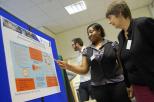
UN Research Students are invited by the Graduate School to enter the University’s Research Poster competition, which takes place on Wednesday 8th May. The winner will receive a £100 prize, with two runner-up prizes of £75.
The aim of this event is for students to create a poster that explains their research to a mixed audience of non subject-specialists. The poster competition is open to all research students from all years of study. If you are in your first year, you can just present preliminary results or some data and ideas for further consideration. Supervisors are invited to come along and support their students on the day.
Read the rest of this entry
Improve your research skills with a little help from CfAP
 Choosing the right tool to analyse your data or finding the best way to structure your findings can be a fraught process. However help is on hand from the Centre for Achievement and Performance – otherwise known as CfAP.
CfAP exists to help all students, including those doing research degrees, achieve their academic potential:
“If you were training for the Olympics you may need to work on aspects of weight, speed or flexibility to improve your performance and to gain insights into how your body works. Visiting CfAP should be regarded in a similar way – you wish to work on aspects of your academic work to improve your performance and to gain a better understanding of how you learn. As with athletes, taking responsibility for your own development leads to success.”
(Sandy Gilkes, National Teaching Fellow)
CfAP staff have recently created a new site on NILE; it is open to everyone and there is no need to enrol. The site contains a huge range of materials to support all aspects of academic endeavour. Read the rest of this entry
SAGE permits authors to deposit full text in NECTAR
 As of today, if you have an article published by SAGE Publications you can upload the accepted version of your full text to NECTAR immediately. With no embargo.
SAGE has just announced a review of its author archiving policy and now permits immediate deposit of the post-peer-review, accepted copy of an article in the author’s own institutional repository.
(See details of SAGE’s publishing policies here.)
This represents a very positive response to recent developments in the sector (such as the Finch report and the revised RCUK policy on open access) and means that SAGE can now promote itself as a SHERPA RoMEO ‘Green‘ publisher, along with 349 other publishers including Cambridge University Press, Elsevier, Intellect, John Wiley and Sons, Kluwer, and Public Library of Science.
East Midlands Universities Annual Conference – urgent call for Chairs and presentations!
 Research Students!
The EMU Research Student Conference will be held on September 6th and provides a unique opportunity for East Midlands Universities postgraduate researchers to showcase their research findings. There will be opportunities for 50 ten minute research talks and 14 three minute research snapshot presentations during the conference. AND would you like a chance to chair a session?
If you would like to give a 10 minute presentation or a 3 minute research snapshot you have until April 3rd to register your interest. See the EMU Website for details on how to apply.
You have until April 8th to let me know if you would like to be nominated as a Chair.
Please email me asap.

April & May Graduate School workshops
Here are April and May’s workshops:
18 Apr Consulting as a Career: Institute of Consulting event. 10:30-1:30pm (includes lunch!)
25 Apr Preparing for Transfer 3-5pm
2 May Correlation and regression: basic theory and SPSS 5-7pm
7 May Preparing for conferences and networking 11-1:30pm
9 May Successful research proposals & research ethics 9:30-1:30pm (includes lunch)
16 May Funding your postdoctoral career 4:30-6:30pm
23 May Working with Children (ethical & practical issues for researchers) 5-7pm
30 May Interpretative Phenomenological Analysis 5-7pm
Upcoming events: Academic Poster competition May 8th, Annual Postgrad Research Conference June 27th.
See our full list of workshops, including May and June 2013, complete with Eventbrite links for you to book your place.

