Blog Archives

Tools for scholarly communication – survey results
 A few months ago I invited researchers to take part in a survey of the tools they used to support their own scholarly communication. Northampton’s answers were then combined with those from other universities to create a dataset of over 20,000 responses.
The number of responses from Northampton was relatively small (just 36) so these comments should be read with the appropriate health warnings but I promised to let you know our results.

REF – OPEN ACCESS
Each Unit of Assessment will need to submit a section on “open research”, detailing the submitting unit’s open access strategy, including where this goes above and beyond the REF open access policy requirements, and wider activity to encourage the effective sharing and managment of research data.
To assist us in meeting this criteria, please ensure that all research outputs that are accepted for publication are uploaded to NECTAR as soon as they have been accepted
Note – copyright will be checked, and all publisher’s policies will be respected. What can be made open, will be!
Note – by depositing your work in NECTAR this does not make your work automatically open access.
If you have any questions about embargo periods or credibility of journals that you are looking to publish in please email openaccess@northampton.ac.uk
Open Access Requirements for all journal articles and conference proceedings accepted for publication from the 1st of April 2016 are:
Deposit – within 3 months of acceptance
Embargo Periods – 12 months – Panel A and B (STEM), 24 Months Panel C and D
Tools for scholarly communication – how much do you know?
Which tools do you use to support your research workflow? Are you aware of all the tools that are available?
Utrecht University have put together a list of over 400 tools used by researchers in the course of their research activity and have launched a survey to find out which of these are most commonly used by researchers worldwide.
The Innovations in Scholarly Communication survey takes about 8-12 minutes to complete and will introduce you to a host of tools that you may find useful. The survey can be completed anonymously or you can put in your email address to receive a visual representation of your workflow compared to that of your peer group.

Piirus – connecting researchers
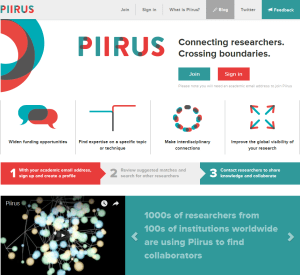 If you are looking for a new research partner or wishing to extend your research network then Piirus may the place to start.
Open to anyone with an academic email address, once you have signed up and entered your own details, Piirus enables you find other researchers with similar interests to your own. Think of it as a research dating service for potential collaborators!
Why not take a look? I’d be interested to hear how you get on.
The Altmetric bookmarklet – a researcher view
“Academics seem to be obsessed with metrics of all kinds at the moment, and I’m certainly not immune to it as my recent post on the h-index demonstrated. So I was intrigued by a new (at least to me) browser plug-in that gives you instant altmetrics such as number of times mentioned on Twitter, Facebook or on news outlets, or cited in blogs, policy documents, Wikipedia, etc. …”
Read more about his experience with the Altmetric bookmarklet in Professor Jeff Ollerton’s blog.

Google Scholar Chrome extension: features and RefWorks integration
If you use Google Chrome and Google Scholar, you’ll probably be interested in the recently released Scholar Chrome extension. I gave the extension a whirl, and here are my notes – including details of its support for RefWorks and Find My Reference.

By any other name: rchive.it, RoMEO and your self-archiving rights
Can you self-archive your e-print? How would you know? What does it even mean? Why am I bothering you with this? These are all perfectly valid questions that may now have a more straightforward answer thanks to a rchive.it. Read on for details of how this web service can simplify an important part of the self-archiving process for NECTAR deposits.

10 ways that PhD students can use Twitter
 Here’s an interesting blog post from the University of Warwick…
To find out what other research students are discussing then try searching Twitter for one of these hashtags: #phdchat; #phdadvice; #phd; #acwri; #phdforum or #gradchat.
If you haven’t used Twitter before then there is plenty of help to get you started.
Image credit: By David Ferreira [CC-BY-SA-3.0 (http://creativecommons.org/licenses/by-sa/3.0)], via Wikimedia Commons

’23 things’ for research
Dr Scott Turner has just drawn my attention to this latest iteration of the ’23 things’ programme: 23 things for research.
The original ’23 things’ programme was designed by Helene Blowers at the public library of Charlotte & Mecklenburg County in North Carolina. Its purpose was to introduce participants to new and emerging technologies. The programme involved a series of 23 tasks or ‘things’, each related to the use of a new tool or service, and lasted nine weeks. As they used the new tools, particpants were expected to maintain a reflective blog on their experiences (Wilkinson and Cragg, 2010, p.29).
This version, ’23 things for research’, is organised by the University of Oxford and aims to “expose you to a range of digital tools that could help you in your personal and professional development as a researcher, academic, student or in another role” (Bodleian Libraries, 2012). It is open to non-Oxford folk.

Citation data and metrics in Google Scholar
Google Scholar has offered basic metrics data for some time, but the service has seen some interesting developments recently that make it easy to discover highly-cited journals and articles for a wide selection of academic disciplines.
 UON Graduate School Blog