Blog Archives

OA and the research lifecycle 2: producing the research proposal
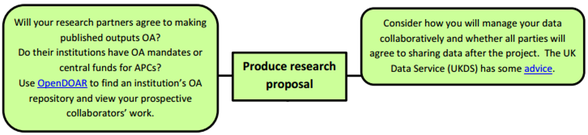
Your research proposal is likely to address a range of issues arising throughout the research lifecycle, some of which are covered by the other posts in this series. To avoid repetition, in this post I will focus on some of the things to consider if you plan to engage with open access in a collaborative project.
OA and the research lifecycle 1: identifying a new research area
 Open access to published work
Whether you already have an idea for a new research area or are uncertain where to start, gaining an overview of the current literature is critical. Fortunately, not all of this is hidden behind paywalls. Thanks to those researchers who have been willing to disseminate their work through open access repositories and journals, there is now a substantial quantity of research available freely to all.
 Much of this is harvested by CORE (COnnecting REpositories). CORE’s mission is to “aggregate all open access research outputs from repositories and journals worldwide and make them available to the public” (About CORE). CORE currently indexes nearly 25 million open access articles.

RDM at the University of Northampton: state of play
Over the last three years the University has been implementing its roadmap for research data management (RDM). This post outlines some of the work that has been undertaken and describes where we are now with respect to support for RDM at Northampton.
The University’s RDM roadmap was created in response to a demand from the Engineering and Physical Sciences Research Council (EPSRC) that Universities in receipt of EPSRC funding must conform to a set of expectations concerning the management of research data. Institutions were (by April 2012) expected to produce a roadmap outlining how they would meet these expectations and then (by April 2015) to implement that roadmap.

Data management planning using DMPonline
In its research data policy and principles, the University of Northampton strongly encourages researchers to produce data management plans (DMPs) for their research projects. DMPonline is the recommended tool for this purpose.
Last year the university’s Research Data Working Group discussed the creation of Northampton-specific guidance for DMPonline users. The tool permits institutions to enter local information about support for data management planning which users will see when they create their DMPs.
For Northampton, the local guidance now covers the University’s policies, procedures and responsibilities for research data management, as well as information about related services (such as TUNDRA2 and NECTAR) that can be used in your DMP.
To see the new University of Northampton guidance in DMPonline you will need to take the following steps when you create your plan:

Using TUNDRA2 for research data: a researcher’s perspective
The University’s research data policy and guidelines place responsibility for good research data management on both the Principal Investigator and the University.
The University is obliged to “provide means and services enabling registration, deposit, storage, retention of and access to digital research data” and to “hold data securely with appropriate access controls”. Its solution for both of these requirements is TUNDRA2.
The UNARS project team have been using TUNDRA2 for their research data and I asked Research Assistant Jo Alexander about the team’s experiences:
Open access and the research lifecycle: a guide for researchers
 Recent funders’ requirements for open access have presented researchers with both opportunities and challenges: opportunities to re-use and re-purpose published outputs and datasets, and challenges in making one’s own work legally and ethically available to others.
Intended for researchers who wish to engage with the open access agenda, but aren’t entirely sure how best to achieve this, this short guide highlights some of the issues to consider at each stage of the research lifecycle and the tools that are available to support you.
Further information about OA at each of the lifecycle stages can be found in these posts.
Download a copy of the guide: PDF (341 KB); DOCX (110KB) [Last updated 10 August 2016]
Acknowledgement: this guide was developed from work undertaken by Nick Dimmock, Katie Jones and Miggie Pickton as part of the JISC-funded Open to Open Access project. We welcome feedback from both Northampton researchers and our professional colleagues.

ESRC announces new research data policy
 Early last week the Economic and Social Research Council published a new research data policy. Aligned with the RCUK Common Principles on Data Sharing, the policy outlines the obligations of ESRC grant holders and their institutions with respect to the collection, management and re-use of research data. A specific requirement is that grant holders should “generate scientifically robust data ready for further re-use” (ESRC).

Data management planning: resources and guides
The creation of a research data management plan (DMP) at the start of a research project is becoming a common requirement. It is increasingly an expectation on the part of funders, sometimes even at the bidding stage, and the University of Northampton’s research data policy and guidance highly recommend it. But what is a DMP and what should it include? Read the rest of this entry

Research data management principles and responsibilities
This morning the University’s Research and Enterprise Committee approved several recommendations put forward by its Research Data Working Group. Among these was the adoption of a new set of research data management (RDM) principles and responsibilities.
The principles are designed to support the University’s research data policy and roadmap, and follow a similar pattern to those in use at a number of other universities. The group hope that these will clarify the university’s expectations of good practice in research data management as well as enabling those bidding for external funding to demonstrate their compliance with funders’ requirements.
The principles and responsibilities are outlined in this document and replicated below.

Conference: Research Data Management in Art and Design
Rachel Jillions of the University of the Arts London has just sent through details of this conference which might be of interest to researchers in Art and Design.
Research Data Management in Art and Design
Thursday 11th December
10:00-16:00
University of the Arts London is holding a one day conference on Research Data Management in Art and Design – ‘Where are we now?’
The conference will be an opportunity to learn about how data management is being addressed in the unique fields of Art and Design from the perspectives of the Arts and Humanities Research Council, University Research and Data Managers, and the Researchers themselves.
 UON Graduate School Blog