Category Archives: Library

The NECTAR journey: from acceptance to compliance
The University’s new Open Access policy – driven by HEFCE requirements for the post-2014 REF – has a simple message at heart for publishing researchers: act on acceptance. In practice, this means timely deposit of items in NECTAR, and we’ve made a few changes to help with this. This post takes a look at the NECTAR workflow, from acceptance to publication.

Important: new open access policy for the University
At last week’s meeting of the University’s Research and Enterprise Committee, members approved a new open access policy for the University. Aligned with, and supporting, HEFCE’s open access policy for the REF, the University policy states:
The University supports the principle of open access and expects researchers to share their research outputs freely, subject to legal, ethical, commercial or contractual constraints.
From 1st April 2016:
• All researchers will record bibliographic details of their research outputs in NECTAR within three months of the date of acceptance for publication, presentation or other dissemination in the public arena.
• The authors of journal articles and conference proceedings will upload the accepted full text copies of their work to NECTAR within three months of acceptance for publication.
• The full content of other research outputs should be deposited In NECTAR as soon as possible.
• All full content will be made openly available immediately or following the expiry of an agreed embargo period.

The Metric Tide: Are you using bibliometrics responsibly?
Recent years have seen an increase in the use of metrics for research assessment. Whether using citation data to support REF scores, calculating an h-index to compare researchers or research groups, or choosing a journal according to its impact factor, researchers, their managers and their funders have become increasingly reliant on quantitative evaluation.
On the face of it, an h-index is an attractive proposition: just one number to sum up both the quantity and the quality of a researcher’s output. Likewise, a journal’s impact factor distils the reputation of the journal into a single metric. Unfortunately, for evaluating the quality of research, many would say that these are reductionist at best and, at worst, fundamentally flawed.
The future of printed academic books
 If you haven’t previously read ‘The Conversation‘ then let me introduce you to this excellent blog with this post on the future of academic print books.
Written by Donald Barclay, Deputy University Librarian at the University of California Merced, the article highlights the impact of falling budgets and rising prices on academic book sales and proposes the open access monograph as a viable alternative. But first, he argues, academic distrust of digital publication has to be overcome…
You talk, we’ll listen: recruiting for new advisory panel
A message to research students from Library and Learning Services:
 “As part of our commitment to meeting the real needs of students we want to recruit Advisors to sit on a new LLS Advisory Panel, where you will help to shape the services, resources, environments and future of LLS.
Commitment would be mainly via a NILE forum, where we would ask for comments on a wide range of issues, but we will also hold occasional, informal Panel lunches.
No special qualifications are needed and you will not be representing anyone’s views but your own. All we ask is that you are interested in shaping how we support your studies and are committed to joining in the discussion.
So if you would like to make a difference and enhance your CV at the same time, please give your name and email address to a library helpdesk or send your details to chris.powis@northampton.ac.uk.”

OA and the research lifecycle 7: disseminating your research
 In deciding whether and how to provide open access to your published work you need to consider:
- The nature of the research output
- Your funder’s open access policy
- The availability of funds to pay article processing charges (if necessary)
- Your publisher’s open access policy
- The availability of an open access subject or institutional repository
OA and the research lifecycle 6: writing up
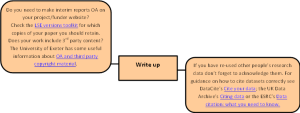 In terms of writing up, the preparation needed for open access is not dissimilar from that required for other types of publication.
A major consideration is whether you have made use of third party copyright material, i.e. material that you did not create or for which you are no longer the rights holder.
There are a number of useful websites which cover this topic, for example the University of Exeter’s Third party copyright page or Taylor and Francis’ Using third party material in your article, but the bottom line is that, unless you qualify for an exception to copyright, you will need the rights owner’s permission to use third party material in your open access work. If you were publishing your paper in a traditional journal, the publisher would make sure that you sought the appropriate permission; if you are making your work open access yourself (for example by uploading your thesis to NECTAR) then it is your responsibility to ensure you do not break the law.
OA and the research lifecycle 5: collecting and analysing data
 If you anticipate that your research data will be re-used in future (either by yourself or others) there are a few things you need to think about as you collect and analyse your data.
Ethical data sharing
“Much research data about people—even sensitive data—can be shared ethically and legally if researchers employ strategies of informed consent, anonymisation and controlling access to data.” (UK Data Archive)
The UK Data Archive (UKDA) and its sister service the UK Data Service are great sources of useful information on the creation and management of data. The UKDA’s ‘consent and ethics‘ web pages cover the key principles of research ethics that have a bearing on data sharing; the legal context of data sharing; all types of consent and how to get it; and the anonymisation of quantitative and qualitative data. They usefully provide sample consent forms and information sheets for various types of research project.
Another useful source is the Australian National Data Service’s guide to publishing and sharing sensitive data.
OA and the research lifecycle 4: conducting the literature review

As a librarian, when I need to conduct a literature review I go first to NELSON, to interrogate the library’s subscription databases. From there I may try the individual databases that are most relevant to my subject (Web of Science, Emerald and so forth), and after that to CORE, to pick up the open access literature.
The advantage of using CORE is that it usually returns a number of results that haven’t appeared elsewhere. This is not only because CORE’s coverage is immense (just under 25 million open access articles) but also because the content it harvests is not restricted to the peer reviewed journal literature: CORE also has research reports, books, conference papers, theses and a host of other grey literature.
OA and the research lifecycle 3: bidding for funding
 Open access to published work
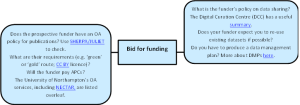
Many funders, especially those awarding public monies, now make it a prerequisite of funding that all published outputs should be made open access. You should make it clear in your bid how you intend to comply with this requirement.
The main issues you need to address at the bidding stage are:
- Does your prospective funder have a policy on open access?
- If so, have they opted for ‘gold’ (made OA by the publisher) or ‘green’ (deposited in an OA repository) open access to published outputs?
- If ‘gold’, are they willing to pay article processing charges (APCs)?
- Do they require open access outputs to be released under a particular licence (e.g. CC BY)?
- Are you and your collaborative partners willing to comply with the funder’s OA requirements?
 UON Graduate School Blog