Author Archives: Miggie Pickton

RDM at the University of Northampton: state of play
Over the last three years the University has been implementing its roadmap for research data management (RDM). This post outlines some of the work that has been undertaken and describes where we are now with respect to support for RDM at Northampton.
The University’s RDM roadmap was created in response to a demand from the Engineering and Physical Sciences Research Council (EPSRC) that Universities in receipt of EPSRC funding must conform to a set of expectations concerning the management of research data. Institutions were (by April 2012) expected to produce a roadmap outlining how they would meet these expectations and then (by April 2015) to implement that roadmap.

Data management planning using DMPonline
In its research data policy and principles, the University of Northampton strongly encourages researchers to produce data management plans (DMPs) for their research projects. DMPonline is the recommended tool for this purpose.
Last year the university’s Research Data Working Group discussed the creation of Northampton-specific guidance for DMPonline users. The tool permits institutions to enter local information about support for data management planning which users will see when they create their DMPs.
For Northampton, the local guidance now covers the University’s policies, procedures and responsibilities for research data management, as well as information about related services (such as TUNDRA2 and NECTAR) that can be used in your DMP.
To see the new University of Northampton guidance in DMPonline you will need to take the following steps when you create your plan:

Guide to open access monograph publishing
The OAPEN-UK project has just published a Guide to open access monograph publishing for arts, humanities and social science researchers. 
The guide has been produced to “assist arts, humanities and social sciences (AHSS) researchers in understanding the state of play with regards to open access in the UK and what it means to them as current and future authors of scholarly monographs” (p.4).
It starts with an overview of open access publishing and business models for monographs and then goes on to address some common concerns of researchers such as legal issues, financial concerns, quality etc.
It is available to read online or download as a PDF.

Using TUNDRA2 for research data: a researcher’s perspective
The University’s research data policy and guidelines place responsibility for good research data management on both the Principal Investigator and the University.
The University is obliged to “provide means and services enabling registration, deposit, storage, retention of and access to digital research data” and to “hold data securely with appropriate access controls”. Its solution for both of these requirements is TUNDRA2.
The UNARS project team have been using TUNDRA2 for their research data and I asked Research Assistant Jo Alexander about the team’s experiences:

21,000 new e-books available
 Submitted by Georgina Dimmock
Library and Learning Services (LLS) has recently acquired three new e-book packages from major publishers, which together provide access to more than 21,000 e-book titles. All the titles are digital rights management (DRM) free, provide simultaneous multi-user access and are available via single sign-on through NELSON and the library catalogue.

Decade: Celebrating ten years of research at Northampton
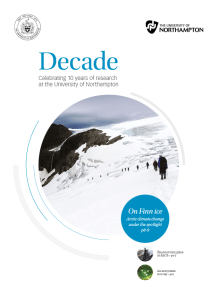 Ten years after achieving full University status and research degree awarding powers, the University is celebrating with a new publication describing some of its current research: Decade: Celebrating 10 years of research at the University of Northampton.
It’s a gorgeous publication showing a wide range of projects and featuring some stunning photographs. Those of you who attended the Images of Research exhibition will recognise a few of them.
Tips for effective conference presentations
 Having spent the day at yesterday’s excellent Postgraduate Research Conference, Professor Jeff Ollerton has some useful advice for prospective presenters.
You can read Jeff’s post on his blog here.
Photo credit: HeppDesigns
New trial: SAGE Video
 SAGE Video comprises video collections in the social sciences and covers the subject areas of education; media, communication and cultural studies; and counseling and psychotherapy. Content includes tutorials, interviews and practical advice.
The website is currently in test mode and the full site will be launching soon. Approximately 50% of the videos are currently live on the site, and SAGE aim to have all the content in the collections by July 2015. In the meantime, you can view a complete list of titles here. There is also a ‘Help Page’ for guidance on using the SAGE Video platform features.
The trial to SAGE video is available on campus only.
Hannah Rose, Academic Librarian for Education, has arranged this trial and would appreciate your thoughts and feedback.

Help with public engagement
Following last week’s Graduate School workshop on ‘delivering research impact’, Dr Scott Turner drew my attention to the work of the National Co-Ordinating Centre for Public Engagement (NCCPE).
Scott writes:
 Did you know there is a body, the National Co-Ordinating Centre for Public Engagement, which has been set up to support Universities across the UK to increase the quality and quantity of their public engagement activities. The University has signed their Manifesto.
Part of the NCCPEs remit is proving a wide range of training or CPD activities on public engagement.
Read the rest of this entry

Open access and the research lifecycle: a guide for researchers
 Recent funders’ requirements for open access have presented researchers with both opportunities and challenges: opportunities to re-use and re-purpose published outputs and datasets, and challenges in making one’s own work legally and ethically available to others.
Intended for researchers who wish to engage with the open access agenda, but aren’t entirely sure how best to achieve this, this short guide highlights some of the issues to consider at each stage of the research lifecycle and the tools that are available to support you.
Further information about OA at each of the lifecycle stages can be found in these posts.
Download a copy of the guide: PDF (341 KB); DOCX (110KB) [Last updated 10 August 2016]
Acknowledgement: this guide was developed from work undertaken by Nick Dimmock, Katie Jones and Miggie Pickton as part of the JISC-funded Open to Open Access project. We welcome feedback from both Northampton researchers and our professional colleagues.
 UON Graduate School Blog