
OA and the research lifecycle 6: writing up
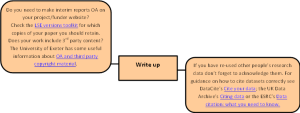 In terms of writing up, the preparation needed for open access is not dissimilar from that required for other types of publication.
A major consideration is whether you have made use of third party copyright material, i.e. material that you did not create or for which you are no longer the rights holder.
There are a number of useful websites which cover this topic, for example the University of Exeter’s Third party copyright page or Taylor and Francis’ Using third party material in your article, but the bottom line is that, unless you qualify for an exception to copyright, you will need the rights owner’s permission to use third party material in your open access work. If you were publishing your paper in a traditional journal, the publisher would make sure that you sought the appropriate permission; if you are making your work open access yourself (for example by uploading your thesis to NECTAR) then it is your responsibility to ensure you do not break the law.
OA and the research lifecycle 5: collecting and analysing data
 If you anticipate that your research data will be re-used in future (either by yourself or others) there are a few things you need to think about as you collect and analyse your data.
Ethical data sharing
“Much research data about people—even sensitive data—can be shared ethically and legally if researchers employ strategies of informed consent, anonymisation and controlling access to data.” (UK Data Archive)
The UK Data Archive (UKDA) and its sister service the UK Data Service are great sources of useful information on the creation and management of data. The UKDA’s ‘consent and ethics‘ web pages cover the key principles of research ethics that have a bearing on data sharing; the legal context of data sharing; all types of consent and how to get it; and the anonymisation of quantitative and qualitative data. They usefully provide sample consent forms and information sheets for various types of research project.
Another useful source is the Australian National Data Service’s guide to publishing and sharing sensitive data.
OA and the research lifecycle 4: conducting the literature review

As a librarian, when I need to conduct a literature review I go first to NELSON, to interrogate the library’s subscription databases. From there I may try the individual databases that are most relevant to my subject (Web of Science, Emerald and so forth), and after that to CORE, to pick up the open access literature.
The advantage of using CORE is that it usually returns a number of results that haven’t appeared elsewhere. This is not only because CORE’s coverage is immense (just under 25 million open access articles) but also because the content it harvests is not restricted to the peer reviewed journal literature: CORE also has research reports, books, conference papers, theses and a host of other grey literature.

Do you own or work with rabbits?
Submitted by Dr Wanda McCormick.
 Have you 15 minutes to spare?
Can you help us with our online survey?
We are currently trying to find out information about handling methods used by people who own and work with rabbits. Little research has looked at the different methods of handling rabbits and your answers to our questions will help add to our knowledge and to future guidelines that may be developed.
If you own, show or work with rabbits please fill in our Rabbit handling survey.
For further information contact: Wanda McCormick or Clare Ellis
OA and the research lifecycle 3: bidding for funding
 Open access to published work
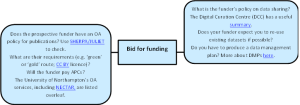
Many funders, especially those awarding public monies, now make it a prerequisite of funding that all published outputs should be made open access. You should make it clear in your bid how you intend to comply with this requirement.
The main issues you need to address at the bidding stage are:
- Does your prospective funder have a policy on open access?
- If so, have they opted for ‘gold’ (made OA by the publisher) or ‘green’ (deposited in an OA repository) open access to published outputs?
- If ‘gold’, are they willing to pay article processing charges (APCs)?
- Do they require open access outputs to be released under a particular licence (e.g. CC BY)?
- Are you and your collaborative partners willing to comply with the funder’s OA requirements?
Workshops coming up: “Creativity in Research” and “Influencing, negotiating and networking”
 We have a treat for all our postgraduate research students and early career researchers on 4th November, in the shape of excellent trainer, broadcaster and consultant Dr Adair Richards.
Adair will be running two workshops, in the morning Creativity in Research, and in the afternoon Influencing, negotiating and networking.
OA and the research lifecycle 2: producing the research proposal
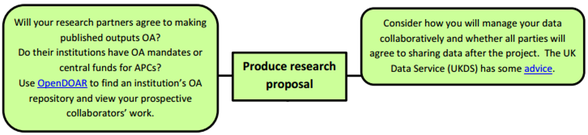
Your research proposal is likely to address a range of issues arising throughout the research lifecycle, some of which are covered by the other posts in this series. To avoid repetition, in this post I will focus on some of the things to consider if you plan to engage with open access in a collaborative project.
OA and the research lifecycle 1: identifying a new research area
 Open access to published work
Whether you already have an idea for a new research area or are uncertain where to start, gaining an overview of the current literature is critical. Fortunately, not all of this is hidden behind paywalls. Thanks to those researchers who have been willing to disseminate their work through open access repositories and journals, there is now a substantial quantity of research available freely to all.
 Much of this is harvested by CORE (COnnecting REpositories). CORE’s mission is to “aggregate all open access research outputs from repositories and journals worldwide and make them available to the public” (About CORE). CORE currently indexes nearly 25 million open access articles.

Online tutorials for PGR students and early career researchers
There are now five new interactive tutorials on the Skills Hub. You will find them in a new section ‘Postgraduate Research Skills‘ on the ‘Academic Skills‘ tab.
- Author bibliometrics – examines the key author bibliometrics and their use
- Journal bibliometrics – explores the use of impact factors and other metrics for ranking journals
- Journals and articles – addresses your publication strategy, journal types and what makes a ‘good’ paper
- Other forms of publishing – covers posters, exhibitions, creative works, website authoring and Open Access publishing
- Networking – making the most of face to face and online networking with fellow researchers
Open Access Week webinars
 Next week (October 19th to 25th) is international Open Access Week. It is a great time to catch up on what open access means for you and your research. Here at Northampton we will mark the occasion with a series of posts on the subject of open access throughout the research lifecycle. These will expand on the guide we produced earlier this year and will hopefully answer some of the questions you may have. Look out for them here on the Research Support Hub.
Other organisations are celebrating Open Access Week with various events, including a number of webinars which are, of course, open to everyone. Why not check out some of these?

